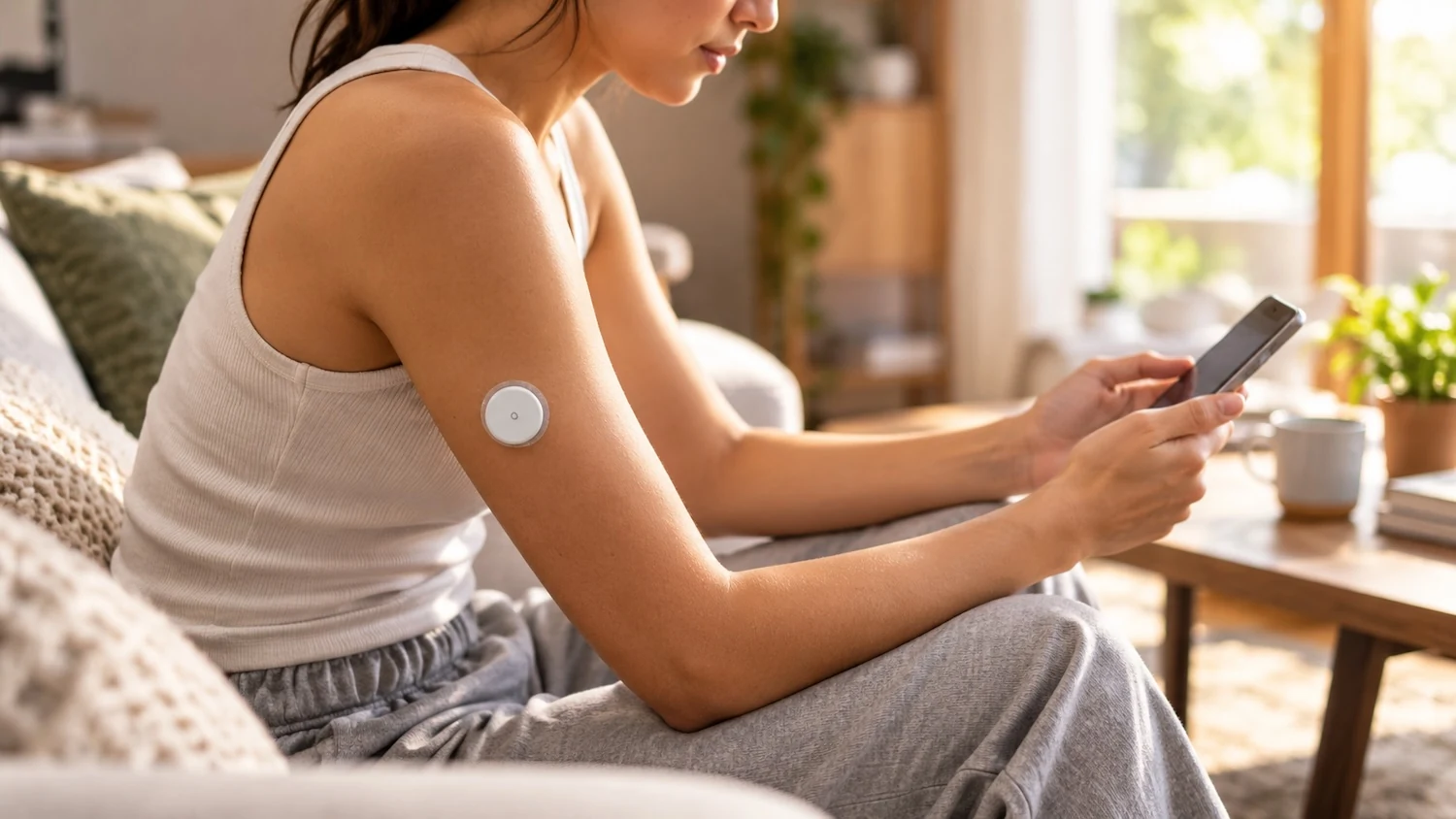
What can a continuous glucose monitor (CGM) tell me?
What continuous glucose monitors measure, how they differ from HbA1c and finger-prick tests, and what to discuss with your doctor.
· 5 min read
A continuous glucose monitor (CGM) is a small sensor worn on the skin that reads your glucose level around the clock. Unlike a finger-prick meter or a lab blood test, which capture a single moment, a CGM measures glucose in the fluid between your cells every few minutes and tracks how it rises and falls with meals, exercise and sleep.
It is mainly a tool for managing diabetes, where it adds day-to-day detail that HbA1c and single blood tests cannot show, without replacing them. For anyone else, whether a CGM would tell you anything useful is a conversation to have with your doctor.
What is a continuous glucose monitor, and how does it work?
A CGM is a wearable sensor with a thin, flexible filament that sits just under the skin, usually on the upper arm or belly. It sends readings to a phone app or a reader, so you can check your level without pricking your finger.
The filament sits in interstitial fluid, the fluid between your cells. The glucose level there is very similar to blood glucose, which is how a CGM can follow your blood sugar without drawing blood. You can apply most sensors yourself at home with a simple applicator.
What can CGM data show that a blood test can't?
A CGM shows how your glucose moves through the day and night, while a blood test captures a single moment. You can see which meals cause a sharp rise and whether your level dips while you sleep.
For people with diabetes, a CGM report shows how much of the day is spent inside the target range your doctor sets. A level below 4.0 mmol/L is low blood sugar, or hypoglycaemia (mmol/L is the unit for blood glucose used in Singapore), and a CGM alarm can warn you of a low during the night. The data helps most when you and your care team agree in advance on how you will act on it.
How accurate is a CGM compared to a glucometer?
A CGM reading is usually close to what a finger-prick meter (glucometer) shows, though the two can differ, especially when your glucose is changing quickly.
Glucose reaches the fluid between your cells a little later than it reaches your blood, so after a meal or during exercise the CGM may lag behind the meter. For safety, NIDDK, a US health institute, advises a finger-prick check if you doubt a reading, if the CGM gives a warning or when your insulin dose changes. Some models also need finger-prick tests to calibrate them. That is why it makes sense to keep a glucometer at home, and a separate article explains how to take an accurate finger-prick reading.
How is CGM data different from HbA1c?
HbA1c reflects your average blood sugar over 3 months, while a CGM shows the day-to-day detail behind that average. Two people with the same HbA1c can have very different days, one steady and the other swinging between highs and lows.
Many CGM apps also show an estimated HbA1c, called the glucose management indicator (GMI). It is calculated from sensor readings, so it may not match your lab result, and doctors still rely on the lab HbA1c for diagnosis and treatment targets. The HbA1c article covers what HbA1c measures in more depth.
Do I need a CGM if I don't have diabetes?
A CGM is mainly a tool for managing diabetes. In people without diabetes, glucose rises after meals and settles back on its own, so a CGM is not a diagnostic tool — a lab test is what tells you where you stand.
That said, some people wear a CGM for a few weeks to understand how their own body responds to particular foods, meal timing, exercise or sleep. This can be useful for someone making deliberate changes to their diet and lifestyle, because it shows the effect of specific choices in real time rather than just the end result on a lab report months later.
The readings are also easy to over-read: a rise after a white rice meal is expected and does not mean you have diabetes. If your real concern is diabetes risk, regular diabetes screening with a fasting glucose or HbA1c test is what answers it.
How do I choose a good CGM?
Once your doctor agrees a CGM suits you, compare models on these points:
- Real-time or scan to read: real-time CGMs send readings to your phone or reader automatically. Intermittent-scan (flash) sensors measure all the time, but you scan them with a phone or reader every few hours to see and store the data.
- Alarms: look for high and low alerts you can set. They matter most if you take insulin or have had lows you did not notice.
- Wear time: disposable sensors are replaced every 7 to 14 days, depending on the model. Some implanted sensors can last up to 180 days.
- Calibration: some models come calibrated from the factory, while others need regular finger-prick checks.
- Phone compatibility: check that the app works with your phone and can share data with your care team.
- Comfort: size, adhesive and water resistance matter if you swim or play sport.
- Local supply: buy from a pharmacy or clinic in Singapore, since most medical devices must be registered with the Health Sciences Authority (HSA) before they can be sold here, and make sure replacement sensors are easy to get.
Ask your care team about help with costs. MOH has said CGM subsidies currently go mainly to people with type 1 diabetes, and it is reviewing whether some groups of people with type 2 diabetes should also be covered.
FAQs
- What is a continuous glucose monitor, and how does it work?
- A CGM is a wearable sensor with a thin, flexible filament that sits just under the skin, usually on the upper arm or belly. It sends readings to a phone app or a reader, so you can check your level without pricking your finger.
- What can CGM data show that a blood test can't?
- A CGM shows how your glucose moves through the day and night, while a blood test captures a single moment. You can see which meals cause a sharp rise and whether your level dips while you sleep.
- How accurate is a CGM compared to a glucometer?
- A CGM reading is usually close to what a finger-prick meter (glucometer) shows, though the two can differ, especially when your glucose is changing quickly.
- How is CGM data different from HbA1c?
- HbA1c reflects your average blood sugar over 3 months, while a CGM shows the day-to-day detail behind that average. Two people with the same HbA1c can have very different days, one steady and the other swinging between highs and lows.
- Do I need a CGM if I don't have diabetes?
- A CGM is mainly a tool for managing diabetes. In people without diabetes, glucose rises after meals and settles back on its own, so a CGM is not a diagnostic tool — a lab test is what tells you where you stand.
- How do I choose a good CGM?
- Once your doctor agrees a CGM suits you, compare models on these points:
References & Sources
- Continuous Glucose Monitoring https://www.niddk.nih.gov/health-information/diabetes/overview/managing-diabetes/continuous-glucose-monitoring
- Self-monitoring of blood sugar https://www.healthhub.sg/programmes/diabetes-hub/self-monitoring-of-blood-sugar
- Hypoglycaemia https://www.healthhub.sg/programmes/diabetes-hub/hypoglycaemia
- Treatment targets and monitoring https://www.healthhub.sg/programmes/diabetes-hub/treatment-targets-and-monitoring
- Evaluating cost-effectiveness of broader continuous glucose monitoring adoption and plans to expand subsidies https://www.moh.gov.sg/newsroom/evaluating-cost-effectiveness-of-broader-continuous-glucose-monitoring-adoption-and-plans-to-expand-subsidies-/
Note: This content is for general informational purposes only and is not medical advice, diagnosis or treatment. It does not replace consultation with a qualified healthcare professional. If you have concerns about your health, please consult a qualified physician.
Read Next: Diabetes runs in my family. What should I keep track of?
You might also like
My blood sugar is high. What is a normal blood sugar level?
Understand Singapore’s blood sugar ranges, what a high result can mean, and why trends and follow-up testing matter.
Metabolic Health · · 7 min read
What is HbA1c, and what is a normal HbA1c level?
Understand what HbA1c measures, Singapore’s screening ranges, and why it can differ from a fasting blood glucose result.
Metabolic Health · · 6 min read
What is prediabetes, and can it be reversed?
Understand Singapore’s prediabetes ranges, common risk factors, and how sustained lifestyle changes can help.
Metabolic Health · · 5 min read