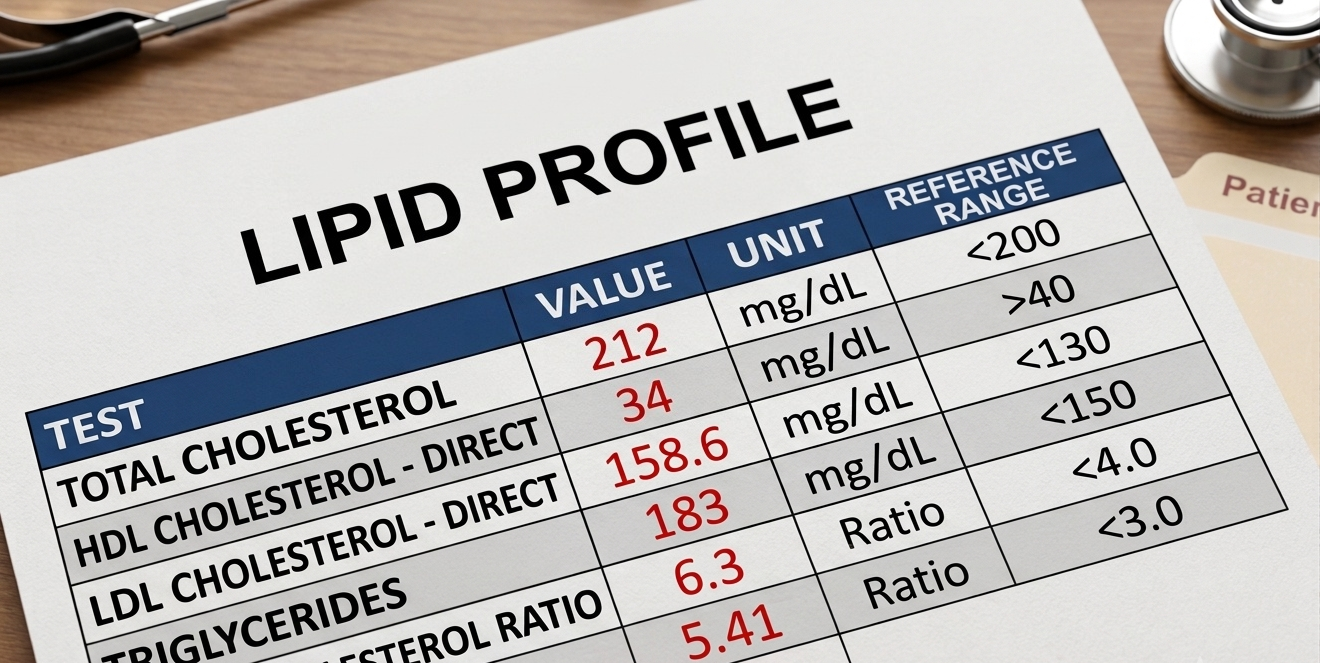
My cholesterol is high. What does it actually mean?
A cholesterol report, also called a lipid profile, contains several measurements: LDL cholesterol, HDL cholesterol, triglycerides, and total cholesterol. A flagged result may mean that LDL, triglycerides or total cholesterol is higher than the laboratory’s reference range, or that HDL is low. Your doctor interprets these results alongside your overall heart-health risk.
· 6 min read
Elevated cholesterol is one of the key indicators of cardiovascular health and is associated with an increased risk of heart disease over time. In Australia, Heart Foundation guidance explains that cholesterol results should be interpreted alongside your overall risk of heart disease, rather than on their own.
Understanding your numbers in the context of your age, lifestyle, family history, and how they have changed over time gives you a much more useful picture than a single flagged result.
What is cholesterol?
Cholesterol is a waxy lipid produced primarily by your liver. Your body needs it to build cell structures, produce hormones, and synthesise vitamin D.
Because cholesterol does not dissolve in blood, it travels through your bloodstream packaged inside transport particles called lipoproteins. Cholesterol itself is not harmful. The concern arises when certain lipoproteins, particularly LDL, remain elevated over time. Excess cholesterol can then deposit in your artery walls, creating plaque buildup that progressively narrows blood vessels. This gradual process, called atherosclerosis, is the underlying mechanism behind most heart attacks and strokes.
What do the numbers on my cholesterol test mean?
A standard lipid panel measures several components, each telling a different part of the story.
Total cholesterol is the overall sum of cholesterol in your blood. It provides a useful starting summary, but can be misleading on its own if your individual numbers are unbalanced.
LDL cholesterol, often called "bad" cholesterol, carries cholesterol from your liver to the rest of your body. When LDL levels are persistently elevated, excess particles can accumulate in artery walls, forming plaque that restricts blood flow. LDL is the primary target in most cholesterol management guidelines.
HDL cholesterol, known as "good" cholesterol, absorbs excess cholesterol and carries it back to the liver to be removed. Higher HDL is generally protective, but it does not cancel out the risk of high LDL.
Triglycerides are a type of fat used to store unused calories for energy. High triglyceride levels, especially combined with high LDL or low HDL, significantly increase cardiovascular risk.
Non-HDL cholesterol is calculated by subtracting HDL from total cholesterol. It represents all potentially harmful cholesterol types combined and is increasingly used by doctors as an indicator of heart disease risk.
Doctors also sometimes look at cholesterol ratios (such as total cholesterol to HDL) for a clearer picture of overall risk.
What are normal and high cholesterol ranges on a lipid test?
Australian Pathology Tests Explained gives the following numerical flags for reviewing an adult lipid profile. These are laboratory flags, not a classification of your overall heart-disease risk.
| Marker | Below the listed high-result flag (mmol/L) | At or above the listed high-result flag (mmol/L) |
|---|---|---|
| Total cholesterol | Below 5.5 | 5.5 or above |
| LDL cholesterol | Below 3.0 | 3.0 or above |
| Non-HDL cholesterol | Below 4.0 | 4.0 or above |
| Triglycerides | Below 2.0 | 2.0 or above |
HDL is different: the concern is a low result. Pathology Tests Explained lists HDL of 1.0 mmol/L or lower in men and 1.2 mmol/L or lower in women as flags for review.
Your laboratory may use different reference intervals, so check the ranges printed on your report. Being below a high-result flag does not necessarily mean you have reached your personal treatment target. Your doctor considers the whole lipid profile and your other risk factors; high HDL does not cancel out high LDL.
Ask your doctor when to repeat your cholesterol test. In Australia, cholesterol is considered as part of overall cardiovascular-risk assessment, but the interval for a routine risk review is not the same as follow-up of a high result. You may need an earlier test if your cholesterol is high or you start or change treatment.
Which cholesterol number matters most?
Doctors usually focus most closely on LDL cholesterol because elevated LDL is the primary driver of fatty buildup in blood vessel walls. However, there is no single target that applies to everyone. Non-HDL cholesterol and Apolipoprotein B (ApoB) can add useful information, especially when triglycerides are elevated.
Your cholesterol is evaluated alongside risk factors including age, blood pressure, blood sugar levels, smoking status, and family history of early heart disease. An LDL of 3.4 mmol/L is not automatically reassuring because someone is young or has no other known risk factors. Your doctor can explain what the result means for you and whether you need lifestyle changes, treatment or follow-up.
Does high cholesterol immediately put you at risk of heart disease?
High cholesterol increases your risk over time, but a high result alone does not diagnose existing heart disease or tell you that a heart attack is about to happen.
Atherosclerosis, the buildup of fatty deposits in artery walls, often develops over years or decades. A heart attack can happen if a plaque ruptures and a blood clot blocks blood flow to the heart. Blood pressure, diabetes, smoking and family history also influence risk, but you do not need to have several known risk factors for high LDL to matter.
A high reading is best understood as an early signal and an opportunity to take proactive steps to protect your heart health over the long term. The earlier you act, the more effective those interventions tend to be.
The importance of tracking cholesterol over time
A single blood test only shows a snapshot. To understand where your cardiovascular health is heading, you need to look at the direction of change across multiple tests.
Consider this example of an LDL cholesterol trend:
| Screening year | LDL cholesterol (mmol/L) |
|---|---|
| 2024 | 2.7 |
| 2025 | 3.0 |
| 2026 | 3.4 |
An LDL of 3.4 mmol/L needs to be interpreted against your personal target. Viewing all three results together also shows an upward pattern, giving your doctor useful context for reviewing what has changed and what follow-up you may need.
This is where Genie can help. Instead of leaving your cholesterol history scattered across PDFs from different health screenings, you can upload your reports to Genie and keep them together.
Genie can organise your LDL, HDL, triglycerides and other biomarkers over time, alongside other health information such as blood pressure readings, health history and supported data from your wearables and smartwatch.
You could ask:
"How has my cholesterol changed across my last three health screenings, and what else in my health information has changed at the same time?"
FAQs
- What is cholesterol?
- Cholesterol is a waxy lipid produced mainly by the liver. Your body uses it to build cells, make hormones and synthesise vitamin D. It travels through the blood in particles called lipoproteins; the concern is when certain particles, particularly LDL, stay elevated over time.
- What do the numbers on my cholesterol test mean?
- Total cholesterol gives an overall figure, but can hide an imbalance. LDL carries cholesterol from the liver and can contribute to plaque in arteries when elevated; HDL carries excess cholesterol back to the liver. Triglycerides store unused calories, while non-HDL cholesterol represents the potentially harmful cholesterol types combined. Your doctor interprets the numbers together with your health history.
- What counts as high cholesterol on a lipid test?
- Australian Pathology Tests Explained lists total cholesterol of 5.5 mmol/L or above, LDL of 3.0 or above, non-HDL of 4.0 or above and triglycerides of 2.0 or above as laboratory flags for review. HDL of 1.0 mmol/L or lower in men, or 1.2 or lower in women, is flagged as low. Your laboratory may use different ranges, and your personal treatment targets may be lower.
- Which cholesterol number matters most?
- Doctors usually focus on LDL because elevated LDL can drive plaque buildup in artery walls. Non-HDL cholesterol and ApoB can add information, particularly when triglycerides are elevated. The right target depends on other factors including age, blood pressure, blood sugar, smoking and family history.
- Does high cholesterol immediately put you at risk of heart disease?
- A high result increases longer-term cardiovascular risk, but it does not by itself diagnose heart disease or predict an immediate heart attack. Plaque often builds up over years or decades. High LDL matters even without other known risk factors; blood pressure, diabetes, smoking and family history add to the picture. Review your result and follow-up plan with your doctor.
- How can Genie help me understand a high cholesterol result?
- You can upload health-screening reports to Genie so your LDL, HDL, triglycerides and other biomarkers are kept together across tests. Genie can show those trends alongside health information such as blood pressure, health history and supported wearable data, helping you prepare questions about what changed between screenings.
References & Sources
- Blood cholesterol — Heart Foundation. https://www.heartfoundation.org.au/your-heart/high-blood-cholesterol
- Cholesterol — healthdirect Australia. https://www.healthdirect.gov.au/cholesterol
- Australian guideline and calculator for assessing and managing cardiovascular disease risk. https://www.cvdcheck.org.au/
- HDL (Good), LDL (Bad) Cholesterol and Triglycerides — American Heart Association. https://www.heart.org/en/health-topics/cholesterol/hdl-good-ldl-bad-cholesterol-and-triglycerides
- The Role of Non-HDL Cholesterol and Apolipoprotein B in Cardiovascular Disease: A Comprehensive Review. https://pmc.ncbi.nlm.nih.gov/articles/PMC12295744/
- Atherosclerosis. https://www.ncbi.nlm.nih.gov/books/NBK507799/
- Lipid profile (cholesterol and triglycerides) — Pathology Tests Explained. https://ptex.au/ptests.php?q=Lipid+profile+%28cholesterol+and+triglycerides%29
Note: This content is for general informational purposes only and is not medical advice, diagnosis or treatment. It does not replace consultation with a qualified healthcare professional. If you have concerns about your heart health, please consult a qualified physician.
Read Next: LDL, HDL and triglycerides explained: which cholesterol number matters?