How Combining Wearable Sleep Data and Health Markers Explains Your Health
Learn what wearable sleep stages mean, how much deep and REM sleep you need, which biomarkers affect sleep, and how poor sleep shows up in HbA1c, cholesterol and hs-CRP.
Genie Health Editorial Team · · 12 min read
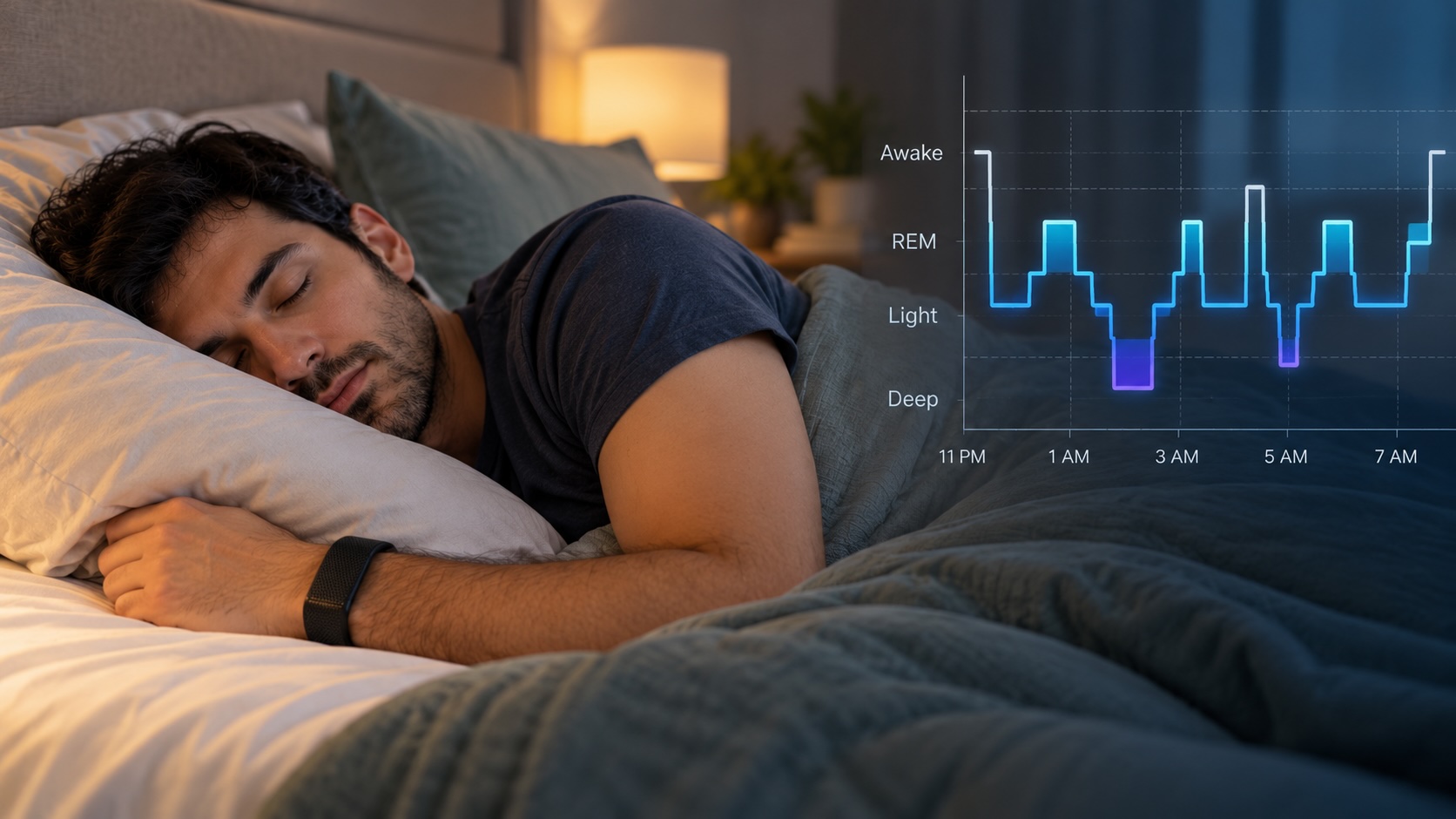
Modern wearables such as Oura, WHOOP, Fitbit, Garmin, Apple Watch and Google's Pixel Watch track how long you sleep, how efficiently you sleep, and how your night splits between light, deep and REM sleep. Each morning, that data is distilled into a score that tells you how well you slept.
These scores are often treated as lifestyle numbers, yet they are closely tied to what happens inside your body. Your vitamin D level, iron stores, thyroid function and stress hormones can all shape how you sleep. In turn, months of short or broken sleep can show up in your blood sugar, cholesterol, inflammation and hormone levels.
Reading your wearable sleep data alongside your health screening results gives you a far more complete picture, and helps you and your doctor spot patterns that either source would miss on its own.
Understanding wearable sleep stages and ideal targets
Through the night, your brain cycles through light, deep and REM sleep roughly every 90 minutes, and each stage does a different job. This structure, called sleep architecture, says more about sleep quality than total hours alone. Sleep labs measure stages through brain activity, while wearables estimate them from heart rate, heart rate variability and movement.
What is Total Sleep Time? Is it useful?
Total sleep time (TST) is the time you were actually asleep, which is usually less than the time you spent in bed. It is one of the most useful sleep metrics because wearables measure it most accurately, and because it sets the ceiling for every stage. On five hours of sleep, there is simply less time available for deep and REM sleep.
How much sleep is enough? The American Academy of Sleep Medicine recommends that adults regularly get at least seven hours of sleep a night. The National Sleep Foundation puts the healthy range at 7 to 9 hours for adults aged 18 to 64, and 7 to 8 hours for those aged 65 and older. Regularly sleeping less than seven hours is linked to a higher risk of weight gain, type 2 diabetes, high blood pressure and heart disease.
TST is best read alongside sleep efficiency, the percentage of time in bed you spend asleep. An efficiency of around 85% or higher is generally considered healthy. Garmin, Fitbit and Oura all factor duration and efficiency into their sleep scores.
Light sleep
What is light sleep? Light sleep is the transition stage between being awake and falling into deeper sleep. In clinical terms, it covers stages N1 and N2. In Apple Health, light sleep is labelled Core sleep, while Fitbit, Garmin, Oura, WHOOP and Google simply call it light sleep.
During light sleep, your body temperature drops, your heart rate slows and your muscles begin to relax. Stage N2 in particular is thought to support memory and learning.
Most adults spend around 45% to 55% of the night in light sleep, which works out to roughly 3.5 to 4.5 hours over an eight-hour night.
Deep sleep (slow-wave sleep)
What is deep sleep? Deep sleep, also called slow-wave sleep or stage N3, is the most physically restorative stage. Brain waves slow down, breathing becomes steady, and you are hardest to wake. Most deep sleep happens in the first half of the night. WHOOP labels this stage SWS.
Deep sleep supports physical recovery, muscle repair, tissue growth and cellular regeneration. It is also when the body releases most of its growth hormone, and it plays an important part in immune function and in how well the body handles blood sugar.
Adults need around 15% to 25% of their total sleep in deep sleep, or roughly one to two hours a night. Deep sleep naturally declines with age, so a lower share in your 50s or 60s is common.
REM sleep (rapid eye movement)
What is REM sleep? REM sleep is the stage most associated with vivid dreaming. Your brain becomes highly active, close to waking levels, while most of your muscles are temporarily paralysed. REM periods get longer as the night goes on, so much of it happens in the early morning hours.
REM sleep supports cognitive processing, memory consolidation, emotional regulation and overall brain health. Cutting sleep short at the end of the night tends to cost you REM sleep in particular.
Adults need around 20% to 25% of their total sleep in REM, or roughly 1.5 to 2 hours a night. WHOOP combines deep and REM sleep into a single figure it calls restorative sleep, a useful way to think about the two stages that matter most for recovery.
Awake time and restlessness
Almost everyone wakes briefly several times a night, usually without remembering it. Wearables record these moments as awake time, restlessness or wake after sleep onset. Oura shows restless periods, Fitbit and Google show time awake, and Apple Health logs awake segments within your sleep.
This metric reflects how fragmented your sleep is. Frequent awakenings break up the normal sleep cycle and can cut into deep and REM sleep even when your total hours look fine. Spending more than about 30 minutes awake after first falling asleep is commonly treated as a sign of disrupted sleep.
Here's a quick glance at the typical sleep stage targets for healthy adults.
| Sleep stage | Share of total sleep | Main role |
|---|---|---|
| Total sleep time | 7 to 9 hours a night | Sets the ceiling for every stage |
| Light sleep (Core sleep in Apple Health) | 45% to 55% | Transition into deeper sleep, memory and learning |
| Deep sleep (slow-wave sleep) | 15% to 25% | Physical recovery, growth hormone, immune function, blood sugar control |
| REM sleep | 20% to 25% | Memory, mood and brain health |
| Awake after falling asleep | Typically under 5% | Lower is better; reflects how fragmented sleep is |
Connecting the dots: from wearable sleep data to a whole-health view
Your wearable is very good at showing what is happening. Oura, Fitbit or WHOOP can show that your deep sleep has been low for three weeks or that your nights have become more restless, but it has no way of knowing that your last blood test showed low vitamin D or borderline ferritin.
Your health report works the other way round. It captures your biology at a single point in time, such as a high HbA1c or rising triglycerides, without showing the months of short or fragmented sleep that may have contributed. Each source tells only part of the story. The next sections look at how biomarkers and sleep affect each other in both directions.
Biomarkers that influence your sleep
If your wearable keeps showing low deep sleep or restless nights, something in your biology may be part of the reason. Several factors that can be measured in a blood test have well-documented links to sleep quality. These are some of the most relevant.
Vitamin D
Vitamin D is best known for bone health, but it also appears to play a role in sleep regulation, with vitamin D receptors found in areas of the brain involved in sleep. A meta-analysis of more than 9,000 people found that vitamin D deficiency was associated with a 50% higher risk of sleep disorders, as well as poorer sleep quality, shorter sleep duration and more daytime sleepiness. Levels below 20 ng/mL were linked to a higher risk of unhealthy sleep. Most of this research is observational, so it shows an association rather than proof that low vitamin D causes poor sleep, but it is a common deficiency and a simple one to check.
Iron and ferritin
Iron is needed to produce dopamine, a brain chemical involved in controlling movement. When iron stores (measured as ferritin) run low, some people develop restless legs syndrome, an uncomfortable urge to move the legs that typically gets worse in the evening and can make it hard to fall and stay asleep. Iron deficiency anaemia, reflected in low haemoglobin, has also been linked to a range of sleep disturbances. On a wearable, this can show up as higher restlessness, more awake time and lower sleep efficiency.
Cortisol (the stress hormone)
Cortisol follows a daily rhythm. It peaks shortly after you wake up to help you get going, then gradually falls to its lowest point around bedtime, which allows melatonin, the hormone that signals sleep, to rise. Chronic stress can flatten this rhythm and keep cortisol elevated in the evening. Higher cortisol before bed has been linked to shorter, less efficient sleep, and it makes it harder to settle into deep, restorative sleep. Cortisol is not part of most routine health screenings, but your doctor can test it if stress-related sleep problems are a concern.
Thyroid function (TSH, free T3 and free T4)
Your thyroid sets the pace of your metabolism, and its relationship with sleep runs in both directions. Research on the thyroid and sleep shows that sleep influences the daily release of thyroid-stimulating hormone (TSH), while both too little and too much thyroid hormone can disrupt sleep. An overactive thyroid (hyperthyroidism) can cause difficulty falling asleep, night sweats and a racing heart, which may show up as a higher overnight heart rate on your wearable. An underactive thyroid (hypothyroidism) often brings fatigue and unrefreshing sleep. TSH is included in many standard health screening panels.
Magnesium and B vitamins
Magnesium helps regulate the nervous system, including the calming GABA pathways that help the brain wind down, and it is involved in melatonin production. Low magnesium has been linked to poorer sleep quality, although studies of magnesium supplements for sleep have produced mixed results. Vitamin B6 helps the body convert the amino acid tryptophan into serotonin and then melatonin. In one study, vitamin B6 taken before bed increased how much people remembered of their dreams, a small hint at its role in REM sleep, while vitamin B12 is involved in regulating the body clock. If you suspect a deficiency, a blood test is the best first step.
Biomarkers affected by sleep
Sleep also shapes your biomarkers. Over time, consistently short, shallow or fragmented sleep can show up in your health screening results, sometimes before you notice any other change.
Blood sugar control (HbA1c and fasting glucose)
Sleep has a direct effect on how well your body responds to insulin, the hormone that moves glucose out of your blood. In a well-known experiment, researchers suppressed deep sleep for three nights in healthy young adults without changing their total sleep time. Their insulin sensitivity dropped by about 25%, and the people who lost the most deep sleep saw the largest drop. Population studies add to this picture, linking chronically short or poor-quality sleep with higher fasting glucose, higher HbA1c and a greater risk of type 2 diabetes. If your HbA1c has been creeping up, sleep is one factor worth looking at alongside diet and activity.
Lipid profile (LDL, HDL and triglycerides)
Sleep plays a role in regulating metabolism, inflammation and appetite, all of which feed into your cholesterol results. Research reviewing the influence of sleep on heart and blood vessel health has linked insufficient and disrupted sleep with unfavourable lipid patterns, most consistently higher triglycerides and lower HDL ("good") cholesterol. The link with LDL cholesterol is less clear, with some studies finding a connection and others not. Taken together, ongoing poor sleep is best seen as one of several contributors to an unhealthy lipid profile.
Inflammatory markers (hs-CRP)
High-sensitivity C-reactive protein (hs-CRP) is a blood marker of low-grade inflammation, and elevated levels are associated with higher cardiovascular risk. A large review of cohort and experimental studies found that sleep disturbance, meaning poor quality, fragmented or restless sleep, was associated with higher CRP. Regularly sleeping much longer than average was also linked to higher CRP. The effects are modest, and they suggest that sleep quality matters alongside sleep length.
Hormonal balance (testosterone and growth hormone)
Many of the body's recovery hormones are released during sleep. Growth hormone is secreted mainly in deep sleep, especially in the first deep sleep cycle of the night, so consistently low deep sleep can mean less of this repair signal. Testosterone is also largely released during sleep. In a small study of young, healthy men, one week of sleeping five hours a night lowered daytime testosterone levels by 10% to 15%, a drop comparable to 10 to 15 years of ageing.
Liver enzymes (ALT)
ALT is a liver enzyme included in most standard health screenings, and it is often the first marker to rise when fat starts building up in the liver. Short sleep has been associated with higher ALT and a greater risk of fatty liver disease. The link is especially clear in people with obstructive sleep apnoea, a condition where breathing repeatedly stops and starts during sleep. A meta-analysis found that people with sleep apnoea had higher ALT levels than those without, independent of body weight. Loud snoring, gasping during sleep and persistent daytime tiredness are worth raising with a doctor.
How Genie brings your sleep and health data together
Genie connects with Oura, WHOOP, Fitbit, Apple Health and Google Health, and lets you upload health reports and screening results into your Health Locker, where markers are tracked across reports over time.
Sparks is where those connections appear. These insight cards look across your wearable data and your health reports to highlight patterns and changes. A Connected Signals card might point out that low vitamin D on your last test could be one reason your sleep quality has dipped, or link a stretch of low deep sleep with an HbA1c that has crept up across two reports. Genie helps you see relationships that are easy to miss when you look at one number at a time.
Ask Genie lets you ask questions about your health in plain language, such as "Why has my sleep been so restless lately?" or "Could my sleep be affecting my cholesterol?". Genie considers everything available to it, including your wearable trends, your report history and your family history, and answers in that wider context. It can also help you prepare questions for your next doctor's visit.
Conclusion: sleep and biomarkers tell one story
Deep sleep, REM sleep and night-time awakenings reflect what is happening inside your body, and they shape it in return. Low vitamin D, low iron, thyroid changes or ongoing stress can erode your sleep, while months of poor sleep can push up your HbA1c, triglycerides, hs-CRP and liver enzymes.
Viewing your wearable data and health reports side by side makes these patterns clearer and leads to more focused conversations with your doctor. Sync your wearable and upload your lab reports to Genie to see your complete health picture in context.
FAQs
- What do wearable sleep trackers measure?
- Most wearables, including Oura, WHOOP, Fitbit, Garmin, Apple Watch and Google Pixel Watch, track how long you sleep, how efficiently you sleep, how often you wake, and how your night divides into light, deep and REM sleep. They estimate these from heart rate, heart rate variability and movement.
- What are the stages of sleep?
- Sleep cycles through light sleep, deep sleep and REM sleep roughly every 90 minutes. Light sleep is the transition into deeper sleep, deep sleep supports physical recovery, and REM sleep supports memory and mood. A healthy night includes all three.
- How much sleep do adults need?
- Most adults need 7 to 9 hours of sleep a night, and at least seven hours on a regular basis. Adults over 65 may need slightly less, around 7 to 8 hours.
- What health biomarkers affect sleep?
- Several blood markers are linked to how well you sleep. These include vitamin D, iron stores (ferritin) and haemoglobin, the stress hormone cortisol, thyroid hormones (TSH, free T3 and free T4), magnesium, and B vitamins such as B6 and B12. Levels that are too low or out of range can affect how easily you fall asleep, how often you wake, and how much deep or REM sleep you get.
- How does sleep affect your health markers?
- Ongoing short or poor-quality sleep is linked to changes in blood sugar (HbA1c and fasting glucose), cholesterol and triglycerides, inflammation (hs-CRP), hormones such as testosterone and growth hormone, and liver enzymes (ALT). These changes build up over months of poor sleep.
- Are wearable sleep stages accurate?
- Wearables measure total sleep time fairly well, but their sleep stage figures are estimates. They are most useful for tracking trends over several weeks.
References & Sources
- Gao Q, et al. "The Association between Vitamin D Deficiency and Sleep Disorders: A Systematic Review and Meta-Analysis." Nutrients, 2018. https://pmc.ncbi.nlm.nih.gov/articles/PMC6213953/
- Gaur A. "Anemia and Sleep Disturbances: Mechanisms, Evidence and Clinical Implications." Maedica, 2026. https://pmc.ncbi.nlm.nih.gov/articles/PMC13325773/
- Cortisol and sleep. https://pmc.ncbi.nlm.nih.gov/articles/PMC12109018/
- Shekhar S, Hall JE, Klubo-Gwiezdzinska J. "The Hypothalamic Pituitary Thyroid Axis and Sleep." Current Opinion in Endocrine and Metabolic Research, 2021. https://pmc.ncbi.nlm.nih.gov/articles/PMC8315115/
- He C, et al. "The Mechanisms of Magnesium in Sleep Disorders." Nature and Science of Sleep, 2025. https://pmc.ncbi.nlm.nih.gov/articles/PMC12535714/
- Vitamin B6 and sleep. https://pmc.ncbi.nlm.nih.gov/articles/PMC4772032/
- Tasali E, et al. "Slow-wave sleep and the risk of type 2 diabetes in humans." PNAS, 2008. https://pmc.ncbi.nlm.nih.gov/articles/PMC2242689/
- Kiss M, Cohen O, McAlpine C, Swirski FK. "Influence of sleep on physiological systems in atherosclerosis." Nature Cardiovascular Research, 2024. https://pmc.ncbi.nlm.nih.gov/articles/PMC11567060/
- National Heart, Lung, and Blood Institute. "Sleep and Circadian Rhythms: Cardiovascular Resilience, Mechanisms, Implications and Interventions." 2024. https://www.nhlbi.nih.gov/events/2024/sleep-and-circadian-rhythms-cardiovascular-resilience-mechanisms-implications-and
- Irwin MR, Olmstead R, Carroll JE. "Sleep Disturbance, Sleep Duration, and Inflammation: A Systematic Review and Meta-Analysis of Cohort Studies and Experimental Sleep Deprivation." Biological Psychiatry, 2016. https://pmc.ncbi.nlm.nih.gov/articles/PMC4666828/
- Leproult R, Van Cauter E. "Effect of 1 Week of Sleep Restriction on Testosterone Levels in Young Healthy Men." JAMA, 2011. https://pmc.ncbi.nlm.nih.gov/articles/PMC4445839/
- Obstructive sleep apnoea, fatty liver and liver enzymes (meta-analysis). https://pubmed.ncbi.nlm.nih.gov/23740153/
- Sleep and liver enzymes (ALT). https://pmc.ncbi.nlm.nih.gov/articles/PMC8406810/
- Watson NF, et al. "Recommended Amount of Sleep for a Healthy Adult: A Joint Consensus Statement of the American Academy of Sleep Medicine and Sleep Research Society." Journal of Clinical Sleep Medicine, 2015. https://doi.org/10.5664/jcsm.4758
- Hirshkowitz M, et al. "National Sleep Foundation's sleep time duration recommendations: methodology and results summary." Sleep Health, 2015. https://doi.org/10.1016/j.sleh.2014.12.010
Note: This article is for education and awareness only. Genie does not provide medical advice. Please consult a healthcare professional for anything specific to your health.
Read Next: How Daily Steps Shape Your Biomarkers and Health: The Science of Daily Steps
You might also like

The Office — The Genie Edition
Less PowerPoints and graphs, more the gentle chaos of a few people building a company in one room.
Data & Insights · · 2 min read
Building With No Playbook
There's no archetype for what we're building. We are drawing the map as we walk it.
Data & Insights · · 3 min read
The Teammate Who Never Logs Off
Our MVP doesn't take a salary, doesn't come to standup, and lives mostly inside a terminal.
Data & Insights · · 3 min read